
Top 10 Common IELTS Speaking Mistakes (and How to Fix Them)
Practical Tips to Improve Your IELTS Speaking Score in 2026
IELTS Speaking is one of the most important parts of the IELTS exam. It determines how well you can communicate in real-life English situations. Yet many students struggle with avoidable mistakes that cost them valuable band scores. If you’re preparing for IELTS, understanding these common speaking errors — and how to fix them — can make a big difference in your result.
In this guide, we’ll share the Top 10 Common IELTS Speaking Mistakes and direct strategies to improve. At https://fifthaacademy.pk/, we help students prepare for IELTS with real practice, expert feedback, and proven speaking strategies.
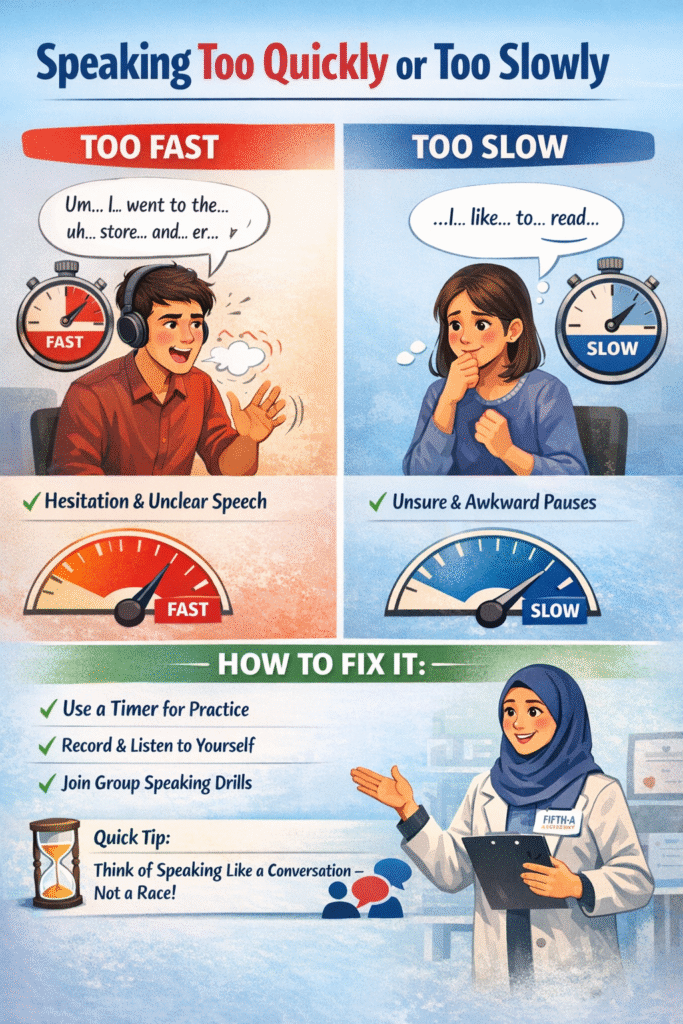
1. Speaking Too Quickly or Too Slowly
Many test-takers either rush through answers or speak so slowly that they lose fluency points.
Why it’s a problem:
• Speaking too fast increases hesitation, stumbles, and unclear speech.
• Speaking too slow makes you sound unsure or unnatural.
How to fix it:
✔ Practice with a timer: aim for a natural pace — not too fast, not too slow.
✔ Record your practice responses and listen for rhythm.
✔ Try group speaking drills at https://fifthaacademy.pk/ where coaches help adjust your timing.
Quick Tip: Think of speaking like a conversation — not a race.
2. Long Pauses and Hesitation
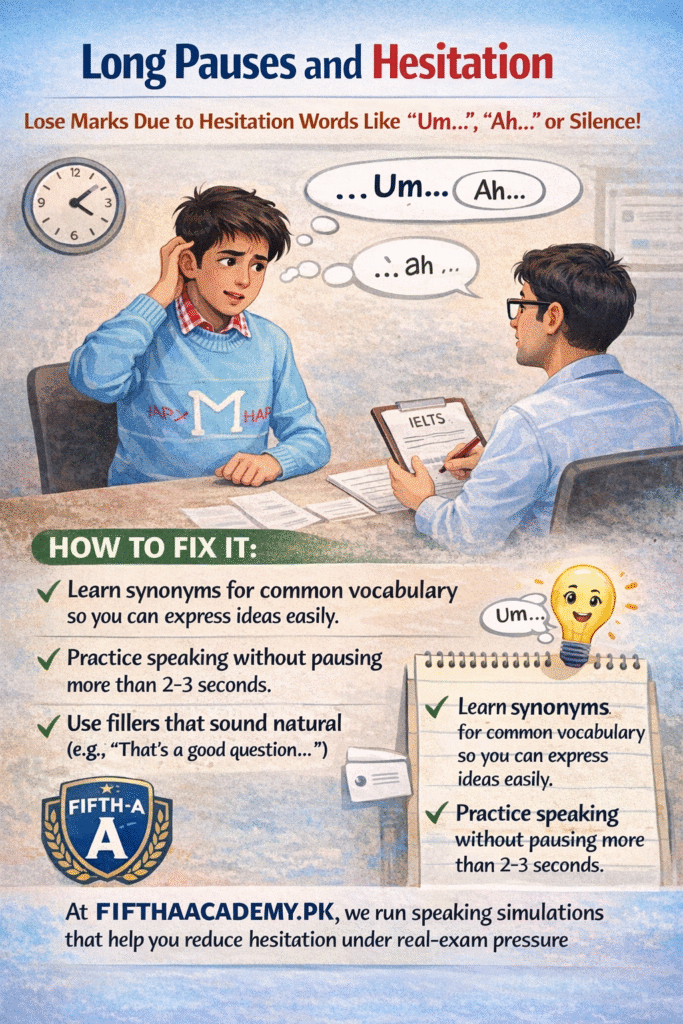
One of the biggest marks lost in IELTS Speaking is due to hesitation filler words like um, ah, or silence.
Why it’s a problem:
✔ Pauses make you look unprepared.
✔ Fluency suffers when you stop to search for words.
How to fix it:
✔ Learn synonyms for common vocabulary so you can express ideas easily.
✔ Practice speaking without pausing more than 2–3 seconds.
✔ Use fillers that sound natural (e.g., “That’s a good question…”).
At https://fifthaacademy.pk/, we run speaking simulations that help you reduce hesitation under real-exam pressure.
3. Repeating Words or Ideas
Repeating the same words or phrases weakens your score in lexical resource.
Example mistake:
“I like reading. Reading is fun. I enjoy reading.”
How to fix it:
✔ Learn alternative vocabulary.
✔ Use paraphrasing: “I enjoy books” instead of repeating reading.
✔ Practice different word forms (read, reader, reading).
A common practice at https://fifthaacademy.pk/ focuses on expanding expression range through repetition drills.
4. Giving Answers That Are Too Short
Short answers (e.g., “Yes.” “No.” “I don’t know.”) show limited communication ability.
Why it’s a problem:
• IELTS examiners want extended responses — 2–3 sentences per question minimum.
How to fix it:
✔ Always add one extra sentence explaining your answer.
✔ Think in Reason + Example format.
✔ Practice extended responses during mock interviews.
For guided speaking practices that help you build long answers, visit https://fifthaacademy.pk/.

5. Using Memorized Phrases
Many students memorize generic answers and bring them to the test.
The issue:
✔ Examiners can tell when answers are memorized, making them less credible.
✔ Memorized phrases often don’t match the question exactly.
Better approach:
✔ Practice flexibility — learn phrases you can adapt.
✔ Understand question types (opinions, experiences, preferences).
✔ Practice speaking freely on different topics.
At https://fifthaacademy.pk/, expert trainers help you prepare adaptable speaking strategies — not memorized scripts.
6. Grammar Mistakes and Sentence Errors
Grammar errors reduce your score in grammatical range and accuracy.
Common errors include:
• Wrong tenses
• Sentence fragments
• Incorrect subject-verb agreement
How to fix it:
✔ Learn basic grammar patterns thoroughly.
✔ Practice speaking full sentences.
✔ Record, review, and correct your mistakes.
You can find helpful grammar speaking exercises at https://fifthaacademy.pk/ that improve both accuracy and confidence.
7. Unclear or Mumbled Pronunciation
Clarity matters! If the examiner can’t understand your pronunciation, your score drops.
Common causes:
• Words run together
• Weak ending sounds
• Misplaced stress
How to fix it:
✔ Practice phonetic sounds.
✔ Speak clearly, stress important words.
✔ Listen and repeat exercises.
Our pronunciation practice sessions at https://fifthaacademy.pk/ help you speak clearly and confidently.
8. Not Answering the Question Directly
Sometimes students go off-topic because they misunderstood the question.
Example mistake:
Q: “Describe a hobby you enjoy.”
A: “I like my job very much.” (which isn’t a hobby)
How to fix it:
✔ Understand the question before starting to answer.
✔ Paraphrase the question first: “So you want me to talk about a fun activity…”.
✔ Take 2 seconds to organize thoughts before speaking.
At https://fifthaacademy.pk/, we teach question-analysis techniques that help you respond accurately.
9. Overuse of Slang or Informal Words
Using too much slang can make your English seem informal or inappropriate.
Why it’s a problem:
✔ IELTS expects neutral, standard English — not casual slang.
Examples to avoid:
• “Cool”, “dude”, “kinda”, “gonna”
Better alternatives:
✔ “Interesting”, “quite”, “going to”
You can learn formal speaking alternatives in lessons available at https://fifthaacademy.pk/.
10. Lack of Practice in Real Situations
Students often only practice alone — but this doesn’t mimic speaking with another person.
How to fix it:
✔ Find speaking partners.
✔ Join mock interview sessions.
✔ Practice with tutors who question naturally.
One of the best ways to improve fluency and confidence is by practicing live — as we do at https://fifthaacademy.pk/ IELTS speaking sessions.
Final Tips to Boost Your IELTS Speaking Score
To turn practice into results:
🎯 Speak English every day — even for 10–15 minutes.
🎯 Record your answers and review mistakes.
🎯 Focus on clarity before complexity.
🎯 Learn vocabulary in topic groups (e.g., Technology, Education).
🎯 Do mock tests with feedback.
Conclusion
Achieving a high IELTS Speaking score doesn’t happen by accident. It requires targeted practice, understanding common mistakes, and applying effective correction strategies. By avoiding these top 10 mistakes and using practical fixes — like those taught at https://fifthaacademy.pk/ — you’ll be much better prepared and confident on test day.
✨ Start practicing today and take your IELTS Speaking score to the next level!