

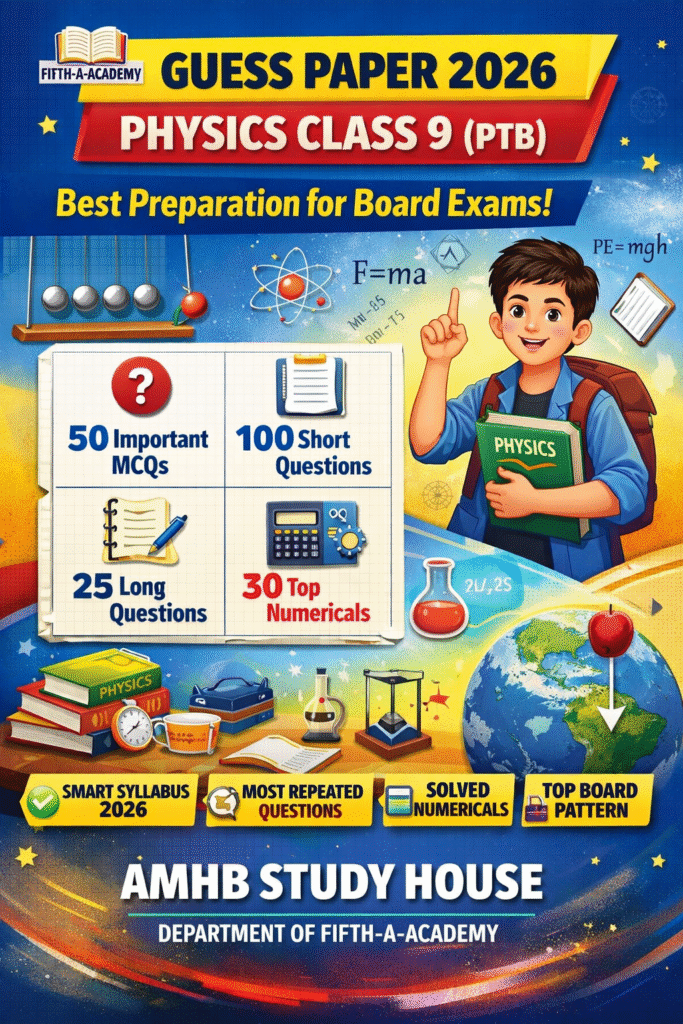
Physics Class 9 Guess Paper 2026
🌐 www.fifthaacademy.pk
🏫 AMHB STUDY HOUSE – DEPARTMENT OF FIFTH-A-ACADEMY
This Class 9 Physics Guess Paper 2026 is specially prepared according to the Punjab Textbook Board (PTB) New Syllabus and Smart Syllabus guidelines. It is designed by analyzing each chapter’s exercise, past paper trends, and most repeated board questions to help students achieve excellent marks in exams.
This guess paper is a complete exam preparation package that includes:
✅ 1. Most Important MCQs (50)
- Fully conceptual and exam-oriented MCQs
- Based on definitions, formulas, and basic concepts
- Designed according to board exam pattern
- Helps students secure easy marks in objective section
✅ 2. Most Important Short Questions (100)
- Selected from exercise questions + conceptual areas
- Covers all chapters of PTB Physics
- Written in simple and exam-relevant language
- Very helpful for short question section in board paper
✅ 3. Most Important Long Questions (25)
- High probability questions from every chapter
- Includes definitions, explanations, and derivations
- Focused on frequently repeated board patterns
- Designed to help students score full marks in theory section
✅ 4. Most Important Numericals (30)
This guess paper by Fifth-A-Academy is a complete guide for students who want to achieve high marks in Class 9 Physics exams 2026. It is carefully prepared to ensure maximum success with minimum effort.

GUESS PAPER 2026 – PHYSICS CLASS 9 (PTB)
🏫 AMHB STUDY HOUSE
DEPARTMENT OF FIFTH-A-ACADEMY
🚫 EXCLUDED TOPICS (SMART SYLLABUS 2026)
Do NOT prepare:
- Errors & Uncertainty
- Types of motion (detail)
- Free body diagrams
- Centre of gravity applications
- Kinetic theory
- Some advanced derivations
✅ PART–I: MCQs (50)
Choose the correct option (All options in one row)
- Physics is the study of:
A) Plants B) Matter & Energy C) Earth D) Animals - SI unit of length is:
A) cm B) meter C) km D) inch - Velocity is:
A) Distance B) Speed with direction C) Time D) Force - Unit of acceleration is:
A) m/s B) m/s² C) m² D) s - Newton’s First Law is called:
A) Law of motion B) Law of inertia C) Law of force D) Law of energy - Force is equal to:
A) m/v B) ma C) mv D) m+a - Unit of force is:
A) Joule B) Watt C) Newton D) Pascal - Work is defined as:
A) F + d B) F × d C) F/d D) d/F - Unit of work is:
A) Newton B) Joule C) Watt D) kg - Kinetic energy formula is:
A) mgh B) ½mv² C) Fd D) ma - Potential energy formula is:
A) mgh B) mv² C) ma D) Fd - Power unit is:
A) Watt B) Joule C) Newton D) kg - Density is:
A) m×v B) m/v C) v/m D) m+v - Pressure is:
A) F×A B) F/A C) A/F D) F+A - Heat flows from:
A) Cold to hot B) Hot to cold C) Equal temp D) None - Temperature unit is:
A) Joule B) Kelvin C) Newton D) Watt - Momentum formula is:
A) ma B) mv C) m/v D) v/m - Unit of momentum is:
A) kg m/s B) Joule C) Watt D) Newton - Work is zero when:
A) Force present B) No displacement C) Velocity high D) Time high - SI unit of time is:
A) minute B) hour C) second D) day
📘 MOST IMPORTANT CONCEPTUAL MCQs (Class 9 Physics PTB 2026)
🌐 www.fifthaacademy.pk
🏫 AMHB STUDY HOUSE
DEPARTMENT OF FIFTH-A-ACADEMY
Q1. Physics is the study of:
A) Life
B) Matter and Energy
C) Plants
D) Animals
Q2. SI unit of length is:
A) centimeter
B) kilometer
C) meter
D) inch
Q3. Quantity having only magnitude is:
A) Scalar
B) Vector
C) Force
D) Velocity
Q4. Quantity having magnitude and direction is:
A) Scalar
B) Vector
C) Mass
D) Time
Q5. Unit of time is:
A) minute
B) hour
C) second
D) day
Q6. Velocity is:
A) Distance
B) Speed with direction
C) Time
D) Force
Q7. Acceleration is change in:
A) Velocity
B) Distance
C) Mass
D) Force
Q8. Unit of acceleration is:
A) m/s
B) m/s²
C) kg
D) N
Q9. Newton’s First Law is called:
A) Law of inertia
B) Law of force
C) Law of energy
D) Law of motion
Q10. Inertia means:
A) Resistance to change
B) Force
C) Energy
D) Speed
Q11. Force is equal to:
A) ma
B) m/v
C) v/t
D) m×v
Q12. SI unit of force is:
A) Joule
B) Newton
C) Watt
D) Pascal
Q13. Work is done when:
A) Force causes displacement
B) Only force acts
C) Only motion exists
D) No movement
Q14. Unit of work is:
A) Newton
B) Joule
C) Watt
D) kg
Q15. Energy is the ability to:
A) Do work
B) Stop motion
C) Increase mass
D) Change time
Q16. Kinetic energy formula is:
A) ½mv²
B) mgh
C) Fd
D) ma
Q17. Potential energy formula is:
A) mgh
B) mv²
C) Fd
D) ma
Q18. Power is rate of:
A) Work
B) Force
C) Mass
D) Speed
Q19. Unit of power is:
A) Watt
B) Joule
C) Newton
D) kg
Q20. Momentum formula is:
A) mv
B) ma
C) m/v
D) v/m
Q21. Unit of momentum is:
A) kg m/s
B) Joule
C) Watt
D) Newton
Q22. Density is:
A) mass/volume
B) volume/mass
C) force/area
D) distance/time
Q23. Unit of density is:
A) kg/m³
B) m/s
C) Newton
D) Joule
Q24. Pressure is:
A) force/area
B) area/force
C) mass/volume
D) work/time
Q25. Unit of pressure is:
A) Pascal
B) Newton
C) Joule
D) Watt
Q26. Heat flows from:
A) Hot to cold
B) Cold to hot
C) Equal to equal
D) No flow
Q27. Temperature measures:
A) Hotness or coldness
B) Mass
C) Force
D) Energy
Q28. Unit of temperature is:
A) Kelvin
B) Joule
C) Newton
D) Watt
Q29. Conduction occurs in:
A) Solids
B) Liquids
C) Gases
D) Vacuum
Q30. Convection occurs in:
A) Liquids and gases
B) Solids
C) Vacuum
D) Metals
Q31. Radiation can travel in:
A) Vacuum
B) Solids
C) Liquids
D) Metals
Q32. Work is zero when:
A) No displacement
B) Force is high
C) Speed is high
D) Time is high
Q33. Newton’s Second Law is:
A) F = ma
B) F = m/v
C) F = v/t
D) F = m+t
Q34. Newton’s Third Law is:
A) Action-reaction
B) Inertia
C) Energy
D) Mass
Q35. Unit of mass is:
A) kg
B) m
C) s
D) N
Q36. Scalar quantity is:
A) Mass
B) Force
C) Velocity
D) Acceleration
Q37. Vector quantity is:
A) Force
B) Mass
C) Time
D) Energy
Q38. Speed is:
A) Distance/time
B) Force/area
C) Mass/volume
D) Work/time
Q39. Displacement is:
A) Shortest distance
B) Total distance
C) Force
D) Energy
Q40. Work depends on:
A) Force and displacement
B) Mass only
C) Time only
D) Speed only
Q41. Energy cannot be:
A) Created or destroyed
B) Increased
C) Stored
D) Changed
Q42. Mechanical energy is:
A) KE + PE
B) Mass + Force
C) Speed + Time
D) Work + Power
Q43. Unit of velocity is:
A) m/s
B) m/s²
C) kg
D) N
Q44. Acceleration due to gravity is:
A) 9.8 m/s²
B) 10 m/s
C) 5 m/s²
D) 1 m/s²
Q45. Weight formula is:
A) mg
B) ma
C) mv
D) m/v
Q46. Unit of weight is:
A) Newton
B) kg
C) Joule
D) Watt
Q47. Pressure depends on:
A) Force and area
B) Mass and volume
C) Time and speed
D) Energy
Q48. Heat energy is measured in:
A) Joule
B) Newton
C) Watt
D) kg
Q49. Liquids have density:
A) Less than solids
B) More than gases
C) Equal everywhere
D) Zero
Q50. Gases are:
A) Highly compressible
B) Not compressible
C) Solid like
D) Heavy
PART–II: SHORT QUESTIONS (100)
📌 Chapter 1–2
- Define physics.
- Define measurement.
- What is SI system?
- Define velocity.
- Define acceleration.
- Difference between speed & velocity.
- What is displacement?
- Define scalar quantity.
- Define vector quantity.
- Write equations of motion.
📌 Chapter 3–4
- State Newton’s First Law.
- State Newton’s Second Law.
- Define inertia.
- What is force?
- Define momentum.
- Define torque.
- What is equilibrium?
- Types of equilibrium.
- Define couple.
- What is turning effect?
📌 Chapter 5–9
- Define work.
- Define energy.
- Types of energy.
- Define power.
- Define density.
- Define pressure.
- Define heat.
- Define temperature.
- Define conduction.
- Define convection.
CHAPTER-WISE EXERCISE ANALYSIS (Class 9 Physics 2026)
🔹 Chapter 1: Physical Quantities & Measurement
- Mostly definitions + SI units
- Concept of measurement instruments is less important (some parts excluded in smart syllabus)
- Focus: units, prefixes, basic concepts
👉 Exam trend: short questions + MCQs
🔹 Chapter 2: Kinematics
- Very important chapter
- Exercise includes:
- definitions of speed, velocity, acceleration
- equations of motion
- numerical problems.
🔹 Chapter 3: Dynamics
- Newton’s laws dominate exercise
- Focus on:
- force and inertia
- F = ma
- action-reaction
🔹 Chapter 4: Turning Effect of Forces
- Basic concepts of torque and equilibrium
- Some parts reduced in smart syllabus
🔹 Chapter 5: Gravitation
- Weight, mass, gravity
- Basic conceptual + short questions
🔹 Chapter 6: Work and Energy
- Very important
- Work, energy, power formulas
- Numerical + conceptual mix
🔹 Chapter 7: Properties of Matter
- Density, pressure
- Conceptual + numericals
🔹 Chapter 8: Thermal Properties
- Heat, temperature, expansion
- Very frequently asked concepts
🔹 Chapter 9: Transfer of Heat
- Conduction, convection, radiation
- Pure conceptual chapter
30 MOST IMPORTANT CONCEPTUAL QUESTIONS
🏫 AMHB STUDY HOUSE
DEPARTMENT OF FIFTH-A-ACADEMY
🔹 Chapter 1: Measurement
- What is physics?
- Define physical quantity.
- What is SI system?
- Difference between base and derived quantities.
🔹 Chapter 2: Kinematics
- Define velocity.
- Differentiate between speed and velocity.
- What is acceleration?
- State equations of motion.
- What is uniform motion?
🔹 Chapter 3: Dynamics
- State Newton’s First Law.
- What is inertia?
- State Newton’s Second Law.
- State Newton’s Third Law.
- Define force.
🔹 Chapter 4: Turning Effect
- What is torque?
- What is equilibrium?
- What is moment of force?
🔹 Chapter 5: Gravitation
- Define gravity.
- Difference between mass and weight.
- What is acceleration due to gravity?
🔹 Chapter 6: Work & Energy
- Define work.
- What is energy?
- State law of conservation of energy.
- Define power.
- Difference between kinetic and potential energy.
🔹 Chapter 7: Properties of Matter
- Define density.
- What is pressure?
- State Pascal’s principle (basic idea).
🔹 Chapter 8: Heat
- Define heat and temperature.
- Differentiate between conduction, convection, and radiation.
✅ PART–III: LONG QUESTIONS (25)
- Explain SI units with examples.
- Derive equations of motion.
- Explain Newton’s laws.
- Define work and energy with examples.
- Explain kinetic and potential energy.
- Explain power.
- Explain density and pressure.
- Explain states of matter.
- Explain heat and temperature.
- Explain transfer of heat.