
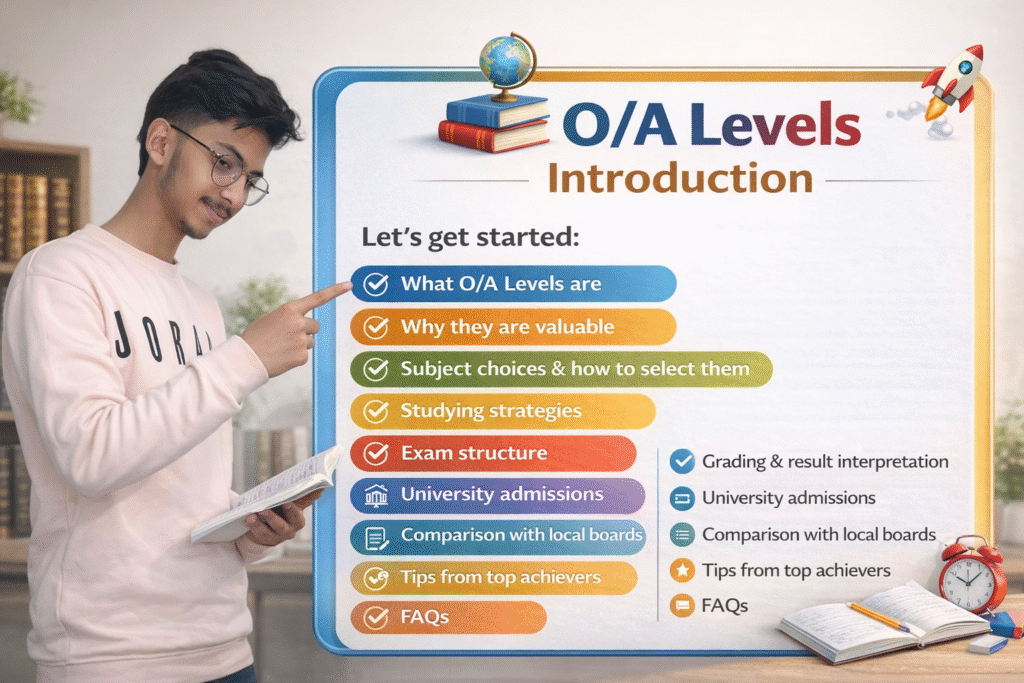
🎓 The Ultimate Guide to O/A Level Education
For Students, Parents & Future Leaders
Published on https://fifthaacademy.pk/
🧠 What Are O Levels?
The General Certificate of Education Ordinary Level (O Level) is a secondary academic qualification typically taken at age 14–16. Students usually complete O Levels after 2–3 years of study, covering core subjects such as:
• English Language
• Mathematics
• Sciences (Physics, Chemistry, Biology)
• Social Sciences
• Humanities
• Languages
O Levels focus on building foundational knowledge and academic skills, preparing students for higher studies, including A Levels.
🎯 What Are A Levels?
The Advanced Level (A Level) is a higher secondary qualification taken at age 16–19. A Levels usually span 2 years and offer deeper, specialized study in fewer subjects.
Instead of studying many topics broadly (like O Levels), A Levels allow students to focus intensely on 3–4 subjects, enabling:
✔ Critical thinking
✔ Independent research
✔ University preparation
✔ Career specialization
Popular A Level subjects include:
• Mathematics & Further Mathematics
• Physics, Chemistry, Biology
• Economics
• Business Studies
• Computer Science
• Accounting
• Psychology
• Sociology
• Law
… and many more
🏆 Why Choose O/A Levels?
Here are some of the most important benefits:
1. International Recognition
O and A Levels are accepted by universities worldwide, including the UK, USA, Canada, Australia, UAE, and many European institutions.
2. Deep Conceptual Learning
The curriculum emphasizes understanding over memorization — a key advantage in higher education.
3. Flexible Subject Choices
Students can choose subjects that match their interests and future career goals.
4. Balanced Assessment
O/A Level exams include essays, projects, structured questions, and practicals — offering balanced evaluation.
5. Strong Preparation for University
A Level graduates are better equipped to handle university challenges because of rigorous academic training.
📘 O Level Subjects: How to Choose
Choosing subjects wisely at O Level matters because it sets the foundation for your A Level future.
Core Subjects
These are usually compulsory:
✔ English Language
✔ Mathematics
Elective Subjects
Examples include:
• Physics, Chemistry, Biology
• Economics, Business Studies
• Urdu, Islamiat, Pakistan Studies
• Computer Science
• History, Geography, Sociology
How to Select Subjects
Ask yourself:
✅ What am I good at?
✅ What am I interested in?
✅ What do I want to study later?
For example:
➡ If you want to join engineering → Science subjects + Mathematics
➡ If you want business studies → Business + Economics + Accounting
➡ If you love languages → Literature + Languages + Humanities
📚 A Level Subjects: How to Decide
At A Level, focus on subjects that align with your career goals.
Science & Engineering Students
Choose:
🔹 Mathematics
🔹 Physics
🔹 Chemistry
🔹 Further Mathematics (optional)
Medical Students
Recommended:
🔹 Biology
🔹 Chemistry
🔹 Physics
🔹 Mathematics (optional)
Business & Economics
Best combinations:
🔹 Accounting
🔹 Business Studies
🔹 Economics
🔹 Mathematics
Arts & Social Sciences
Students may choose:
🔹 Psychology
🔹 Sociology
🔹 Law
🔹 Economics
🔹 Literature
📅 Exam Structure: What to Expect
O Level
Most subjects have:
✔ Written exams
✔ Practical exams (for sciences)
✔ Coursework (in some subjects)
A Level
Assessment includes:
✔ Paper 1, Paper 2, Paper 3 (depending on subject)
✔ Practical work (Sciences)
✔ Projects in some subjects
🧠 Effective Study Strategies
Successful O/A Level students follow certain habits:
1. Plan Your Time
Make a daily study routine with goals. Productivity depends on consistency.
2. Understand, Don’t Memorize
Focus on understanding topics rather than rote learning. This helps in essay-based and application questions.
3. Practice Past Papers
Past papers show patterns and train your exam timing.
4. Make Notes
Write neat notes. They help in revision and improve retention.
5. Seek Help Early
If something is hard — ask a teacher, tutor, or peer. Don’t wait until the exam is near.
🎓 Grading System
O/A Levels use grades like:
📌 A*, A, B, C, D, E, F
Grades indicate mastery of material. A* and A are top scores and help in university admissions.
📈 O/A Levels vs Local Boards (Matric & FSc)
Many parents and students compare O/A Levels with local boards (Matric & FSc). Here’s a simplified comparison:
✔ O/A Levels
• International curriculum
• Flexible subject choices
• Global recognition
• Strong analytical focus
✔ Matric & FSc
• Local curriculum
• Well-structured foundational courses
• Widely accepted in Pakistani universities
Both systems have value — choose what matches your goals.
🎓 University Admissions
O/A Level results are accepted worldwide. Most universities require:
✔ Minimum grade requirements
✔ Predicted or final A Level results
✔ Personal statement & references
✔ Standardized tests (in some countries)
With good grades, O/A Level students can access scholarships and top universities.
🧠 Common Challenges & Solutions
❌ Time Management
➡ Solve by making a timetable and setting priorities.
❌ Tough Subjects
➡ Ask teachers, join study groups, use online resources.
❌ Exam Fear
➡ Practice past papers, revision, self-care, healthy sleep.
🌟 Tips from High Achievers
Here’s what top students recommend:
✔ Start early
✔ Focus on weak areas
✔ Stay consistent
✔ Practice questions, not just notes
✔ Believe in yourself
✨ Final Thoughts
O and A Levels are not just exams — they are life skills courses. They build critical thinking, confidence, discipline, and global readiness. Whether you dream of engineering, medicine, business, or liberal arts — O/A Levels can be your stepping stone to success.
At Fiftha Academy we believe that every student has potential. With the right guidance, resources, and dedication, you can excel in O/A Levels and beyond.
📌 Want Personalized Coaching?
We offer expert guidance, structured lessons, practice resources, and experienced tutors across all O/A Level subjects.
👉 Contact us today
👉 Enroll for classes
👉 Boost your confidence and grades!

FAQs
Q: How many subjects should I take?
A: Usually 8–10 for O Level, 3–4 for A Level, depending on ability and goals.
Q: Which subjects are compulsory?
A: English and Mathematics are commonly required.
Q: Are O/A Levels harder than local boards?
A: They are different in style – O/A Levels focus more on application and critical thinking.