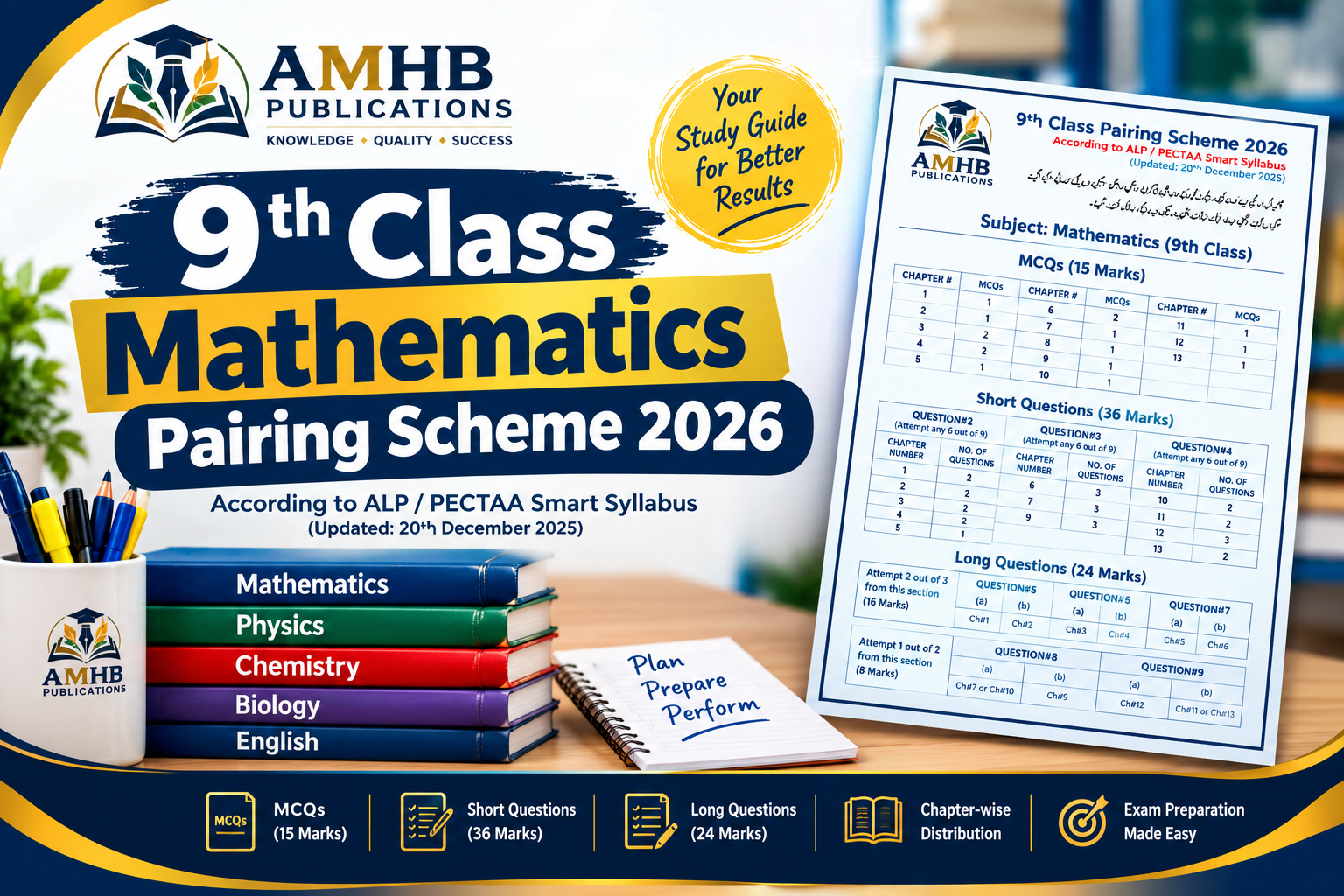

9th Class Mathematics Pairing Scheme 2026
The 9th Class Mathematics Pairing Scheme 2026 is an important resource for students preparing for the upcoming Punjab Board examinations. It helps students understand how questions may be distributed among different chapters and sections of the Mathematics paper.
According to the provided scheme, the paper is organized into MCQs, Short Questions and Long Questions, with a total of 75 marks. Students can use this pairing scheme to organize their preparation, identify important chapters and practice questions according to the expected paper pattern.
Important: A pairing scheme is a preparation guide, not a guarantee of the exact questions that will appear in the examination.
Downlode >>
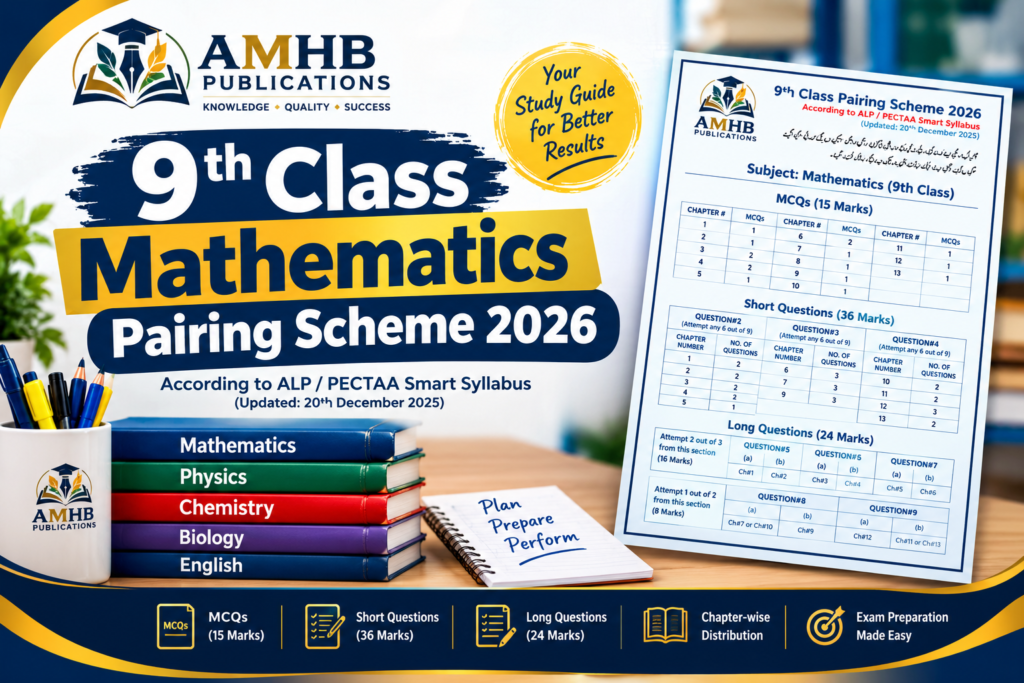
9th Class Mathematics Paper Pattern 2026
The provided pairing scheme divides the Mathematics paper into three major sections:
| Section | Marks |
|---|---|
| MCQs | 15 Marks |
| Short Questions | 36 Marks |
| Long Questions | 24 Marks |
| Total | 75 Marks |
This distribution makes it important for students to prepare all three sections rather than focusing only on long questions.
MCQs Pairing Scheme – 15 Marks
The MCQ section carries 15 marks. According to the provided scheme, MCQs are distributed across Chapters 1 to 13.
| Chapter | MCQs |
|---|---|
| Chapter 1 | 1 |
| Chapter 2 | 1 |
| Chapter 3 | 2 |
| Chapter 4 | 2 |
| Chapter 5 | 1 |
| Chapter 6 | 2 |
| Chapter 7 | 1 |
| Chapter 8 | 1 |
| Chapter 9 | 1 |
| Chapter 10 | 1 |
| Chapter 11 | 1 |
| Chapter 12 | 1 |
| Chapter 13 | 1 |
How should students prepare MCQs?
Students should not ignore any chapter because MCQs can be taken from different parts of the syllabus. A good strategy is to:
- Read important definitions carefully.
- Practice formulas and mathematical concepts.
- Solve textbook MCQs.
- Practice chapter-wise MCQs.
- Revise examples and important results.
- Attempt online Mathematics quizzes regularly.
Short Questions Pairing Scheme – 36 Marks
The short-question portion carries 36 marks and is divided among Question No. 2, Question No. 3 and Question No. 4.
According to the provided pairing scheme, students are required to attempt 6 questions out of 9 in each relevant section.
Question No. 2
The provided scheme shows questions from:
- Chapter 1 – 2 questions
- Chapter 2 – 2 questions
- Chapter 3 – 2 questions
- Chapter 4 – 2 questions
- Chapter 5 – 1 question
This gives students an opportunity to prepare multiple chapters for the short-question portion.
Question No. 3
The scheme shows:
- Chapter 6 – 3 questions
- Chapter 7 – 3 questions
- Chapter 9 – 3 questions
Students should practice short questions from these chapters thoroughly.
Question No. 4
The scheme shows:
- Chapter 10 – 2 questions
- Chapter 11 – 2 questions
- Chapter 12 – 3 questions
- Chapter 13 – 2 questions
Preparation strategy for short questions
For short questions, students should focus on:
- Definitions and concepts.
- Important formulas.
- Short mathematical proofs.
- Textbook examples.
- Exercise questions.
- Frequently practiced problems.
- Step-by-step calculations.
Don’t simply memorize answers. Understanding the method is much more useful because the wording of a question can change in the examination.
Long Questions Pairing Scheme – 24 Marks
The long-question section carries 24 marks.
This section is particularly important because students need to demonstrate complete mathematical working and proper steps.
According to the provided scheme, Questions 5, 6 and 7 form one major section, while Questions 8 and 9 form another.
Questions 5, 6 and 7
The scheme indicates:
- Question 5(a) – Chapter 1
- Question 5(b) – Chapter 2
- Question 6(a) – Chapter 3
- Question 6(b) – Chapter 4
- Question 7(a) – Chapter 5
- Question 7(b) – Chapter 6
Students are required to attempt 2 questions out of 3 from this section, carrying 16 marks.
Questions 8 and 9
The second long-question section includes:
- Question 8(a) – Chapter 7 or Chapter 10
- Question 8(b) – Chapter 9
- Question 9(a) – Chapter 12
- Question 9(b) – Chapter 11 or Chapter 13
Students are required to attempt 1 question out of 2, carrying 8 marks.
Chapter-Wise Preparation Strategy
The pairing scheme can make your preparation more organized, but students should avoid preparing only the chapters that appear to have a higher number of questions.
Chapters 1–5
These chapters are particularly relevant to the first short-question and long-question sections. Students should practice:
- Textbook exercises
- Important examples
- Formulas
- Conceptual questions
- Long problems
Chapters 6–9
These chapters are important for both short and long questions. Give special attention to solving problems step by step.
Chapters 10–13
These chapters appear in the later short-question and long-question portions. Students should prepare their exercises carefully and practice different types of problems.
How to Use the Pairing Scheme Effectively
Simply downloading a pairing scheme is not enough. The best results come from using it as part of a complete study plan.
Step 1: Understand the Paper Pattern
First, understand the distribution of:
15 MCQs + 36 Short Questions + 24 Long Questions = 75 Marks
This helps you divide your study time according to the examination structure.
Step 2: Prepare Every Chapter
Use the pairing scheme to prioritize your revision, but don’t completely skip any chapter.
Step 3: Practice Textbook Exercises
Textbook exercises should form the foundation of your Mathematics preparation.
Step 4: Solve Past Papers
After completing the chapters, solve previous board papers to understand question styles and improve your speed.
Step 5: Practice MCQs
Attempt chapter-wise MCQs and online quizzes to improve your conceptual understanding and accuracy.
Step 6: Take Full-Length Tests
Regular tests can help you identify weak areas before the final examination.
Common Mistakes Students Should Avoid
1. Preparing only selected chapters
A pairing scheme should guide your preparation, not encourage you to completely ignore other chapters.
2. Memorizing solutions
Mathematics requires understanding. Learn the method rather than memorizing a particular solution.
3. Ignoring MCQs
The MCQ section carries 15 marks, so it can significantly affect your overall score.
4. Not showing complete working
In Mathematics, proper steps are important. Practice presenting solutions clearly.
5. Not managing time
Students should practice solving complete papers within the examination time.
9th Class Mathematics Preparation Tips for 2026
Here are some practical tips for students:
- 📚 Complete the textbook first.
- ✏️ Practice questions with a notebook and pen.
- 🧮 Memorize important formulas after understanding them.
- 📝 Solve previous papers.
- 🎯 Attempt chapter-wise tests.
- 🔄 Revise difficult chapters repeatedly.
- ⏱️ Practice with a timer.
- ❌ Don’t leave difficult topics until the last week.
- 💡 Focus on concepts instead of memorization.
- 📊 Analyze your test results and improve weak areas.
Free Online Quizzes for Class 9 Students
Online quizzes are an excellent way to test your preparation. Students can use FIFTH-A-ACADEMY resources to practice MCQs and assess their knowledge.
After studying a chapter, take an online quiz and check your result. If your score is low, return to the relevant chapter, revise it and attempt the quiz again.
This creates a simple cycle:
Study → Practice → Quiz → Check Result → Revise → Improve
Why the 9th Class Pairing Scheme 2026 Is Important
The pairing scheme helps students:
- Understand the expected paper structure.
- Organize their study schedule.
- Identify chapter-wise question distribution.
- Prepare MCQs more systematically.
- Practice short questions effectively.
- Focus on long-question preparation.
- Plan revision before examinations.
However, students should remember that the actual examination paper may differ from the pairing scheme. Therefore, complete syllabus preparation remains the safest approach.
Download 9th Class Mathematics Pairing Scheme 2026
Students can save or download the 9th Class Mathematics Pairing Scheme 2026 and use it during their examination preparation.
For more educational resources, including past papers, MCQs, online quizzes, notes, pairing schemes and exam preparation material, visit:
FIFTH-A-ACADEMY – Your Complete Learning Platform
Frequently Asked Questions
What is the 9th Class Mathematics Pairing Scheme 2026?
It is a preparation guide showing how Mathematics questions are distributed among different chapters and sections of the paper.
How many marks is the 9th Class Mathematics paper?
The provided scheme shows a total of 75 marks.
How many marks are allocated to MCQs?
The MCQ section carries 15 marks.
How many marks are for short questions?
The short-question section carries 36 marks.
How many marks are for long questions?
The long-question section carries 24 marks.
Should I prepare every chapter?
Yes. Use the pairing scheme to organize your preparation, but do not completely skip chapters.
Is the pairing scheme a guarantee of the actual paper?
No. It should be treated as a study and preparation guide, not a guarantee of the exact questions in the board examination.