

Best Memorization Tricks for Complicated Subjects
Smart Memory Aids for Formulas, Biology, and Definitions

Studying complicated subjects like Mathematics, Biology, Chemistry, and English can feel overwhelming. Long formulas, scientific terms, definitions, and processes often confuse students — especially during board exam preparation.
But here’s the good news:
Memorization is not about having a “strong memory.” It’s about using the right techniques.
In this guide, you will learn the best memorization tricks for complicated subjects, including practical memory aids for formulas, biology terms, and definitions. These strategies are easy, science-based, and perfect for SSC, HSSC, and competitive exam students.
Let’s begin. https://fifthaacademy.pk/
Why Students Forget What They Study
Before learning memorization tricks, it’s important to understand why students forget.
- They only read (passive learning).
- They don’t revise properly.
- They memorize without understanding.
- They don’t test themselves.
- They study for long hours without breaks.
If you want long-term memory, you must use active recall, repetition, and visualization techniques.
Now let’s explore powerful memorization strategies. https://fifthaacademy.pk/
1️⃣ Understand Before You Memorize
This is the golden rule.
You cannot memorize what you don’t understand.
For example:
If you try to memorize a biology definition without understanding the concept, you will forget it quickly. But if you understand the idea first, memorizing becomes easy.
How to Apply This:
- Read the topic once.
- Watch a short explanation video.
- Ask your teacher questions.
- Explain it in your own words.
Understanding creates memory anchors in your brain. https://fifthaacademy.pk/

2️⃣ Use Mnemonics (Memory Codes)
Mnemonics are short, funny sentences that help you remember lists or sequences.
Example 1 – Biology (Taxonomy Order)
Kingdom, Phylum, Class, Order, Family, Genus, Species
You can remember it as:
“King Philip Came Over For Good Soup.” https://fifthaacademy.pk/

Example 2 – Math Trigonometry
Sine = Opposite / Hypotenuse
Cosine = Adjacent / Hypotenuse
Tangent = Opposite / Adjacent
Use: SOH CAH TOA
Mnemonics turn boring lists into easy patterns.
3️⃣ The Story Method (Best for Biology & History)
Our brain loves stories.
If you need to memorize a biological process (like digestion or photosynthesis), convert it into a story.
Instead of memorizing steps:
Make it a journey.
Example:
Food enters the mouth → travels through esophagus → reaches stomach → meets acids → goes to small intestine.
Create a fun travel story in your mind.
When exams come, you just recall the story. https://fifthaacademy.pk/

4️⃣ Use Visualization Technique
Visualization is extremely powerful for complicated subjects.
When memorizing:
- Draw diagrams.
- Use colors.
- Highlight keywords.
- Create mind maps.
For Biology:
Draw labeled diagrams yourself.
For Chemistry:
Visualize chemical reactions happening.
For Mathematics:
Write formulas inside boxes and connect them with arrows.
Your brain remembers images 6 times better than text. https://fifthaacademy.pk/

5️⃣ Spaced Repetition (The Smart Revision Formula)
Many students revise only once before exams.
That’s a mistake.
Use this pattern:
- Day 1: Study topic
- Day 2: Quick revision
- Day 4: Revise again
- Day 7: Test yourself
- Day 15: Final revision
This technique is called spaced repetition.
It moves information from short-term memory to long-term memory. https://fifthaacademy.pk/

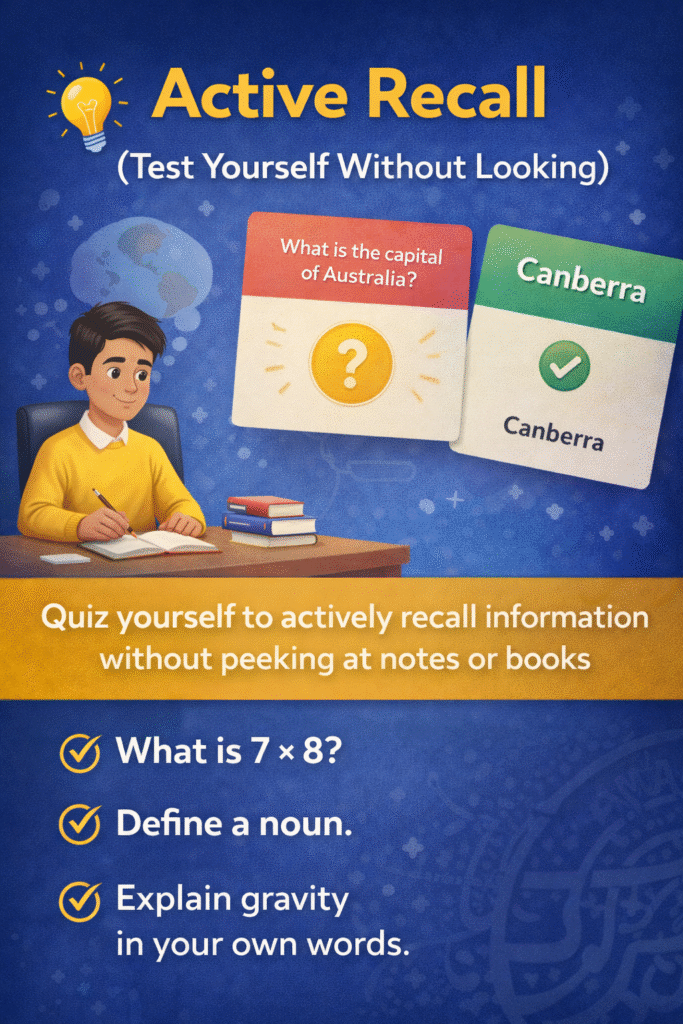
6️⃣ Active Recall (Test Yourself Without Looking)
This is the most powerful memorization method.
Instead of re-reading notes:
Close your book and try to recall everything.
Ask yourself:
- What was the definition?
- What was the formula?
- What are the steps?
This strengthens memory connections.
Pro Tip:
Use flashcards for formulas and definitions.
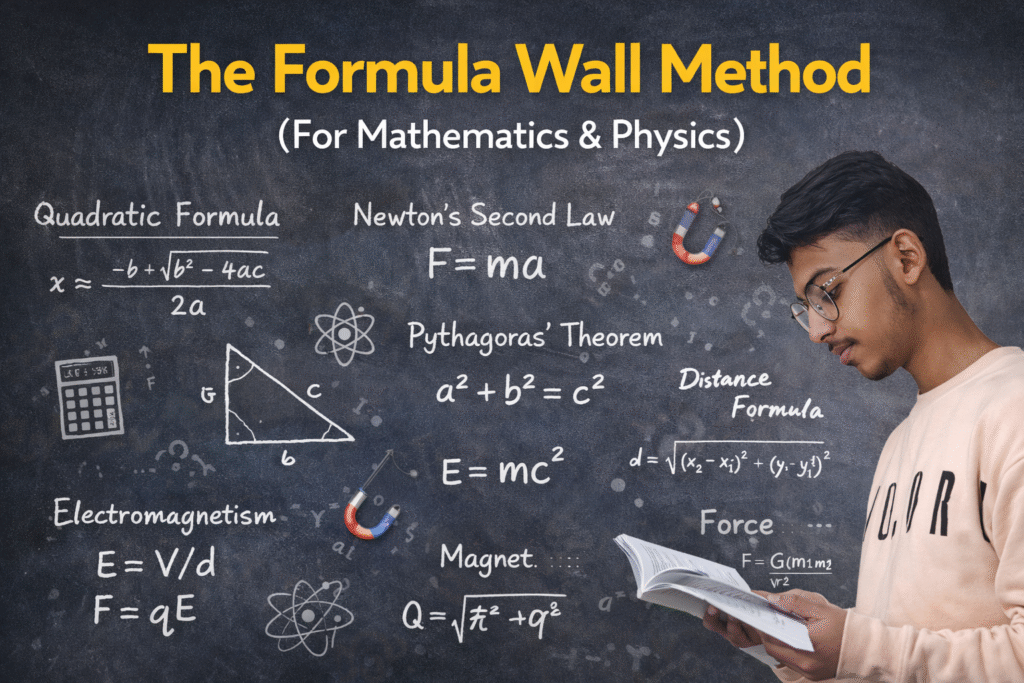
7️⃣ The Formula Wall Method (For Mathematics & Physics)
Formulas are difficult because students try to memorize them randomly.
Instead:
Create a “Formula Wall.”
Write all important formulas on:
- Chart paper
- Sticky notes
- Whiteboard
Place them where you study daily.
Seeing them every day improves passive recall.
8️⃣ The 3R Technique (Read – Recite – Review)
This simple method works wonders.
Step 1: Read the topic carefully.
Step 2: Recite it aloud without looking.
Step 3: Review what you missed.
Speaking out loud activates multiple brain areas.
This is especially helpful for:
- English definitions
- Biology processes
- Theory subjects

9️⃣ Teach Someone Else
If you can teach it, you truly understand it.
After studying:
Explain the topic to:
- A friend
- A sibling
- Even yourself in the mirror
Teaching forces your brain to organize information clearly.
This improves retention.

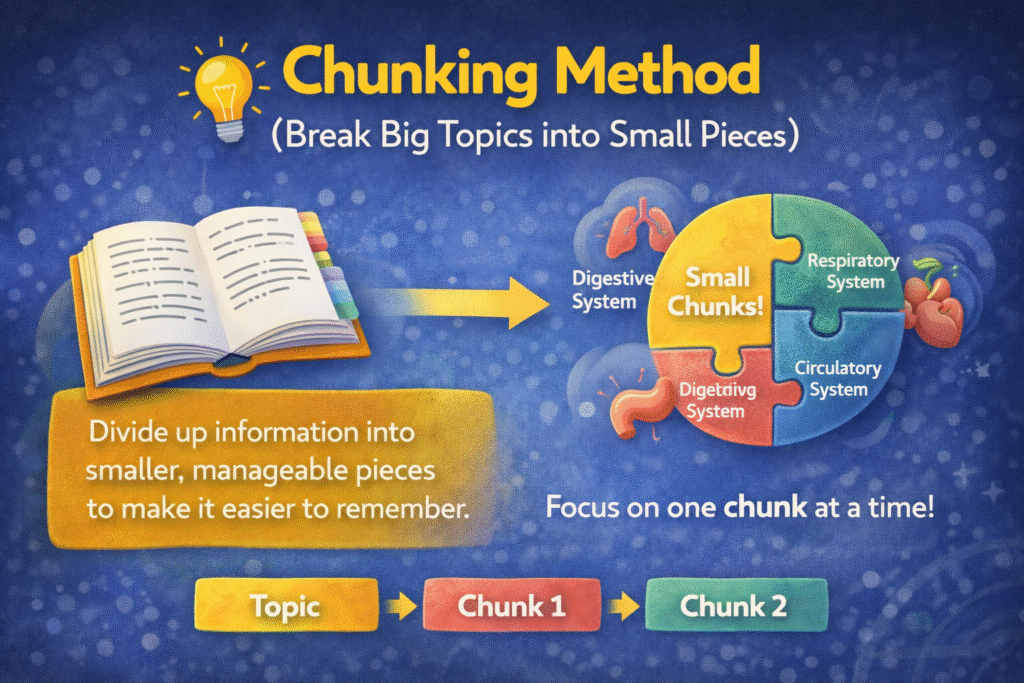
🔟 Chunking Method (Break Big Topics into Small Pieces)
Don’t try to memorize everything at once.
Break it into chunks.
Example:
Instead of memorizing 20 biology definitions together:
Learn 5 at a time.
Instead of 15 formulas:
Group them into categories.
Small pieces are easier to remember.
Memory Tricks for Biology Terms
Biology includes long scientific names that are hard to memorize.
Here’s how to handle them:
1. Break the Word
Example: Photosynthesis
Photo = Light
Synthesis = Combine
Understanding word roots helps memory.
2. Create Short Forms
Example:
ATP – Energy molecule
DNA – Genetic material
Associate each term with one keyword.
3. Use Diagrams Daily
Redraw diagrams again and again.
Rewriting improves memory retention.

Memory Tricks for Formulas
Mathematics and Physics require formula mastery.
Here’s a smart approach:
Step 1: Understand derivation
Step 2: Practice 5 questions immediately
Step 3: Write formula 5 times
Step 4: Use it in real problems
The brain remembers better when information is used practically.

Memory Tricks for Definitions
Definitions are scoring areas in board exams.
Follow this structure:
- Understand meaning.
- Highlight keywords.
- Rewrite in simple language.
- Memorize exact exam wording.
Example:
Instead of memorizing a long biology definition directly,
Rewrite it in short points first.

Healthy Brain Habits That Improve Memory
Memorization is not only about techniques.
It’s also about lifestyle.
✔ Sleep 7–8 hours
✔ Drink enough water
✔ Avoid mobile distractions
✔ Take 5-minute breaks after 45 minutes study
✔ Exercise lightly
A tired brain cannot remember properly.

Common Mistakes Students Make
❌ Studying for 4–5 hours without break
❌ Only reading, not testing
❌ Memorizing without understanding
❌ Leaving revision for last day
❌ Depending only on guidebooks
Avoid these mistakes to improve memory.
Sample 7-Day Memorization Plan
Day 1 – Understand topic
Day 2 – Make notes + mnemonics
Day 3 – Active recall test
Day 4 – Practice questions
Day 5 – Revise weak points
Day 6 – Mock test
Day 7 – Final review
This structured approach builds confidence.
Final Advice for Students
Complicated subjects are not difficult.
They only require:
- Smart strategies
- Regular revision
- Active practice
Memory is like a muscle.
The more you train it, the stronger it becomes.
If you apply even 4–5 techniques from this guide consistently, you will see improvement in:
- Board exam marks
- Confidence level
- Study speed
- Long-term retention
Conclusion
Memorization is not about cramming everything in one night.
It’s about:
Understanding
Visualizing
Repeating
Testing
Teaching
Use mnemonics, visualization, spaced repetition, and active recall to master formulas, biology terms, and definitions effectively.
Start today.